
Play Description
The first dangerous deep yardage play in the Air Raid 5v5 Flag Football Playbook is #13 Three Verts. This play stretches the defense both vertically (10+ yards downfield) and horizontally (sideline-to-sideline). Find the open grass deep to pick up yardage in chunks.
Three Verts puts pressure on your opponent’s Safeties by sending more receivers deep than they are able to cover. Call this play when your pre-snap read is Cover 1 or Cover 2. Leave it to the QB to find or create open grass post-snap.
Assignments & Key Reads
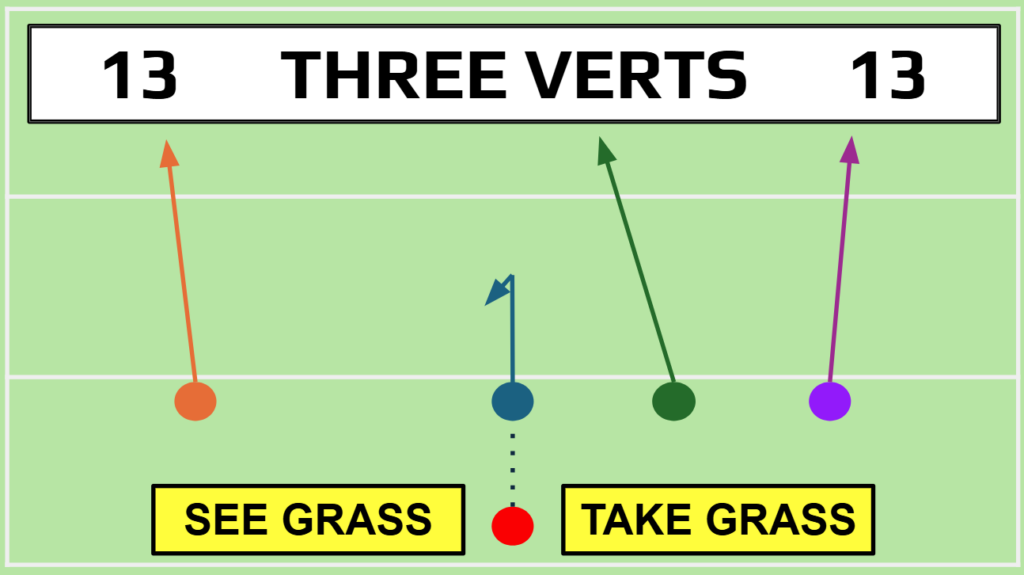
Three Verts is simple in concept based on the 11v11 Four Verticals concept. Three receivers go deep while one stays short as a check down option.
With practice, your QB will be able to move the Safety by pump faking or even just glancing to one side before delivering the ball to a receiver running down the seam or the opposite sideline. This is not a Hail Mary or jump ball throw. Make the read and deliver to the open man.
- WRs (orange and purple) – Outside release toward the CB’s outside shoulder. Get vertical down the sideline. Look for the ball at seven steps.
- Slot (green) – Run a seam route towards the middle of the end zone. Look for the ball at seven steps or earlier if open sooner.
- TE/C (blue) – Five step hitch. This is the QB’s safety valve if pressure is coming and no one’s open.
- QB (red) – Read or move the Safety/Safeties. Find open grass. Deliver the ball in three seconds or less.
Beating the Defense
We really like Three Verts against Cover 1 and Cover 2. It challenges the deep coverage skills of even the best Safeties. By sending three receivers into the deep zones, you are ensuring that at least one will be uncovered. It’s up to the Quarterback to quickly find the open player and deliver the ball before the defense can react.
Avoid calling Three Verts against Cover 3 and Man to Man Coverage (unless your players flat out physically outmatch your opponent).
Beating Cover 1
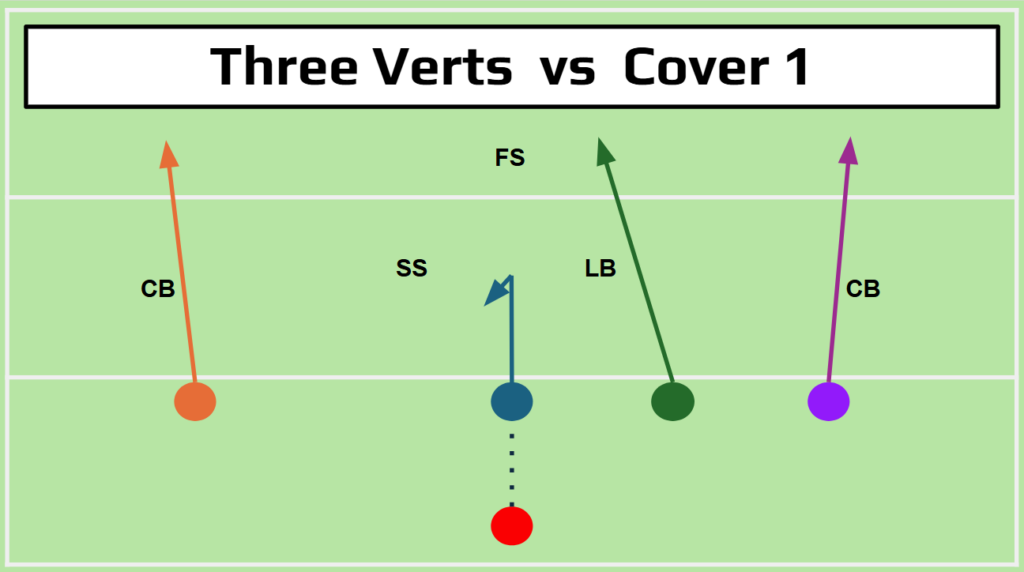
A Cover 1 Safety is in a no-win situation against this play call. Even the most athletic kid can’t cover the entire field against three receivers. The QB simply has to find the Safety and then pick a target running in open grass away from that defender.
Note: Although it is rare, some teams will disguise Cover 3 as a single-high Cover 1. They may line up their CBs close to the line of scrimmage before dropping them into outside third zones at the snap. If a team is giving you a Cover 1 look and you are unsure, run at least one other play to confirm that there is a single player with deep coverage responsibility before calling this play. #21 Deep Cross is a good option to see if the Cornerbacks bail. If both deep routes are covered, you can assume they are disguising their coverage.
Beating Cover 2
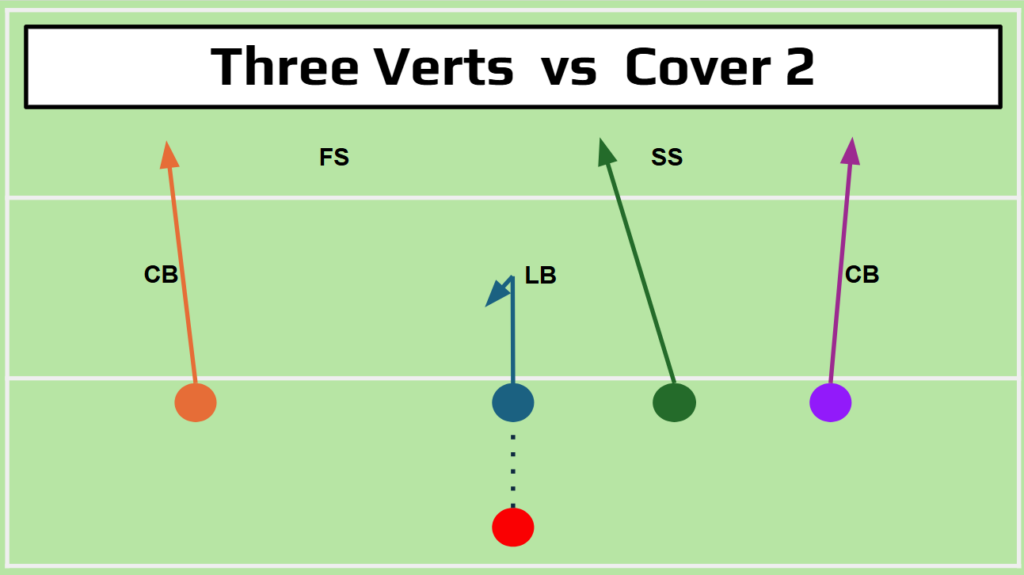
When facing Cover 2, the Safeties typically split to cover the outside receivers running down the sideline. This leaves the Slot receiver open down the seam between the coverage for a big gain.
If a Safety is covering the green receiver, one of the outside receivers is likely uncovered.
Beating Cover 3
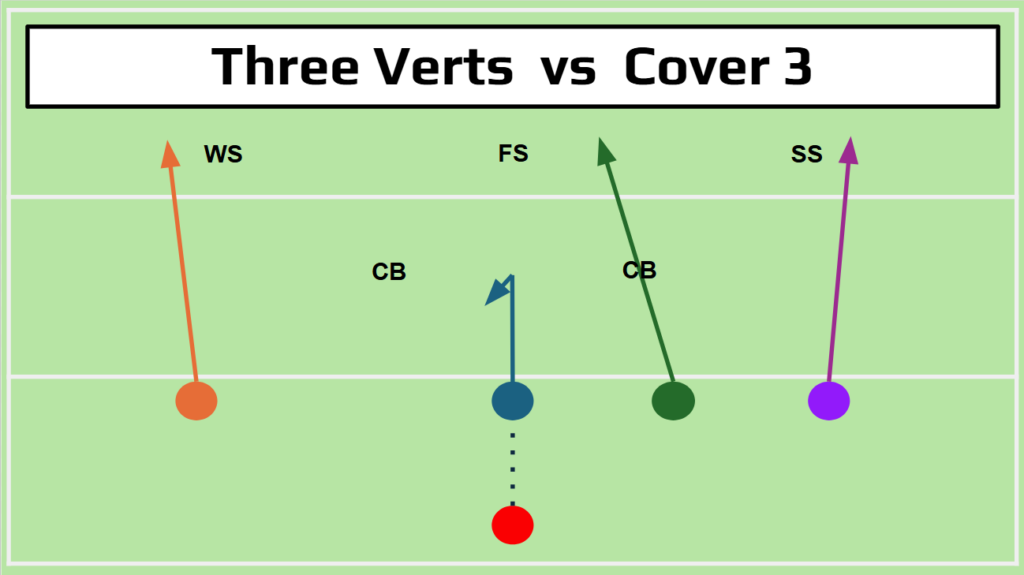
We don’t call Verts against a Cover 3. They have a defender for each deep receiver and two defenders covering the check down route. Try calling #12 All Hitches or #21 Deep Cross instead.
Beating Man Coverage
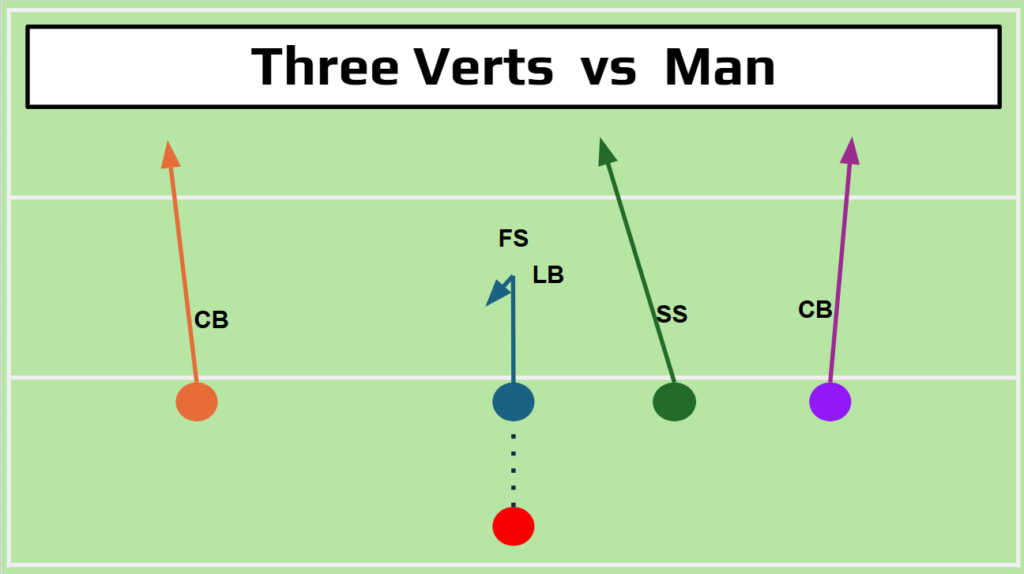
If the defense comes out in Man Coverage, the effectiveness of #13 depends on your athletes. If your players are bigger, faster, and jump higher; you can probably make it work.
If your team is undersized or less athletic, try #22 Mesh or #23 Post-Wheel instead.
Final Notes
Three Verts is the go-to deep threat in the Air Raid 5v5 Flag Football System. Use it to probe your opponent’s defense for weaknesses deep. When you complete one, it’ll be for a big play; and even incompletions will back off an overly aggressive defense opening up more easy completions using plays that attack underneath.
All Hitches and Three Verts are the most straightforward plays in the 5v5 Air Raid Flag Football Playbook. These are normally installed in the first practice to help the players gain some confidence and give the coaches some idea of what they’re working with talent-wise.
The next set of plays all complement each other, using flood concepts and crossing routes to put defenders in conflict and get playmakers in open space.
Check out our guide to reading flag football coverages to get better at calling plays on the fly.
Download Everything You Need Here:
- Offensive Coordinator Package
- Head Coach Package (coming soon)