
Need to create more pressure on the opposing QB? Want to confuse your opponent into more throws into coverage? Are you missing flag pulls that should be sure tackles? The Umbrella 5v5 Flag Football Defense is the most unique flag football defense out there, and it can help your players get critical stops.
It seems every flag football team is running the same vanilla defensive schemes that lack creativity and deception. Most of the time you’ll see a 2-3 Cover 3, a 3-2 Cover 2, a 4-1 Cover 1, or Man-to-Man. Defenses overly concerned with stopping the run might play a 1-3-1 Cover 1, but that is rare as teams become more comfortable passing the ball. Check out our guide to reading defenses if you need a primer on any of these.
If everyone else is running the same defensive schemes, a team that stands out can get the upper hand. Not only do these other teams play the same predictable coverages on gameday, but their offenses practice against these bland schemes every single week. They don’t see novelty very often, and they don’t know what to do when faced with adversity. You can give your team an advantage by showing them something new.
The Four Pillars of the Umbrella 5v5 Defense
1. Umbrella Tackling
“The Umbrella system allows you to show an easy-to-understand diagram that simplifies football for your players. Every player has a role, and if they do someone else’s job then no one does theirs.”
Joe Daniel, 20+ year high school coach
Host of The Football Coaching Podcast
Even when you do everything right, at some point your opponent will get the ball to their playmakers. When that happens, your have to limit the damage. Your team must rally to the ball, stop their forward progress, and pull flags.
The original Umbrella Principals grew out of the 4-2-5 defensive system made popular by Gary Patterson while he was Head Coach of TCU. I learned them from Coach Joe Daniel. Basically, the Umbrella Principles of the 4-2-5 are concerned with stopping the run. Every player has a designated run fitting assignment:
- Spill defenders clog the middle and push the ball carrier outside.
- Force defenders must force everything back inside.
- Alley defenders fill the gap between Spill and Force players.
These principals need only slight modification to create solid team-first tackling rules for flag football.
- Spill defenders are on the backside of the play. They push everything toward the sideline and defend against cutbacks.
- Force defenders have outside contain responsibility. They must force the runner inside before they reach the sideline.
- Alley defenders fill the alley between Force and Spill players, stopping forward progress as they all close the umbrella on the ball carrier.
Before we implemented Umbrella Tackling, our team had a hard time being patient enough to gang tackle. We missed a lot of solo flag pulls when kids would lunge, get juked, our simply outrun. By focusing on this team tackling strategy, we drastically reduced our missed tackles and gave up fewer big plays.
“We want to keep the ball inside of and in front of our defenders at all times.”
Gary Patterson, USC Defensive Coordinator
Former TCU Head Coach
See our Umbrella Tackling drill here.
2. Chaotic Pass Rush
A good pass rush makes a world of difference in flag football. Pressure creates panic in youth Quarterbacks and forces off-balanced throws, incompletions, and interceptions.
Many teams make the mistake of trying to hide an unathletic player in this role. The best teams understand that forcing a youth QB to throw under duress in just 3-4 seconds (or less!) makes the rest of the defense’s job easier. We typically rotate a couple of our quickest kids in this role to keep their legs fresh.
We teach these kids to blitz strategically. Rather than just running straight at the Quarterback, our pass rushers attack from the QB’s dominant side (throwing arm) forcing them to scramble away. This creates the most difficult throws and gives us the best chance at forcing a bad pass when we aren’t able to get a sack.
Our blitzing players don’t lunge for flags on a blitz. They break down to make a fundamentally sound flag pull. If they aren’t going to get there in time, their hands go up to block the pass right as the QB begins his throwing motion. A batted ball or incompletion are almost as good as a sack in most flag football situations, and there is a decent chance they create an interception for one of their teammates.
To be a great pass rusher, you have to be a little crazy. Play fast kids that enjoy creating chaos in the backfield.
3. Zone Coverage
Many coaches make the mistake of thinking that Man-to-Man is the best way to teach defensive coverage. Although it might be easy to tell your players “you cover that kid, and you cover that one, etc.”. It seems simple, but it’s not the most effective nor the best way to teach coverage concepts. One athletic mismatch or simple mistake by your team leads to an easy touchdown for the offense.
There’s a reason roughly 75% of 11v11 high school teams run some form of Zone as their base coverage. It’s more forgiving, more effective, and more reliable than Man.
The Umbrella 5v5 Defense uses a classic spot-drop zone scheme, meaning defenders drop into defined areas of the field and guard anything that comes in their area. This scheme is less popular in tackle football formats than it used to be, but it fits 5v5 flag football perfectly thanks to the smaller field dimensions and simplicity of teaching.
In addition to covering their individual Zone assignments, Zone defenders must communicate. Players are constantly talking to each other during the play, alerting their teammates when a receiver moves from zone to zone.
“DEEP! DEEP! DEEP!”
“CROSS! CROSS! CROSS!”
“BALL! BALL! BALL!”
That’s the sounds of a well coached defense.
4. Deception & Disguise
The Umbrella 5v5 Defense doesn’t give the opposing team easy reads. Our players fake blitzes, line up in multiple positions, and roll coverages often. This deception throws off the opposing coach’s play calling and forces their QB into mistakes.
Although we use deception on nearly every defensive snap, we are still committed to simplicity.
We blitz one player on every single play, but a second player also raises their hand pre-snap to fake blitz and give the offense one more thing to think about. This forces their QB to check both declared blitzers at the snap to see where pressure is actually coming from. This extra hesitation gives the true blitzer a better chance at the sack.
Structurally, the Umbrella 5v5 Defense utilizes just two coverages (Cover 1 & Cover 2) run from just two formations (4-1 & 3-2). Because the defensive coordinator can mix and match their coverages and formations, they have a total of four core defensive calls in addition to fake blitz looks.
The Umbrella 5v5 Defense looks complex to your opponent. In reality, it’s quite simple. Simple concepts create confident defenses. Confident defenses play faster. Faster defenses give up less points.
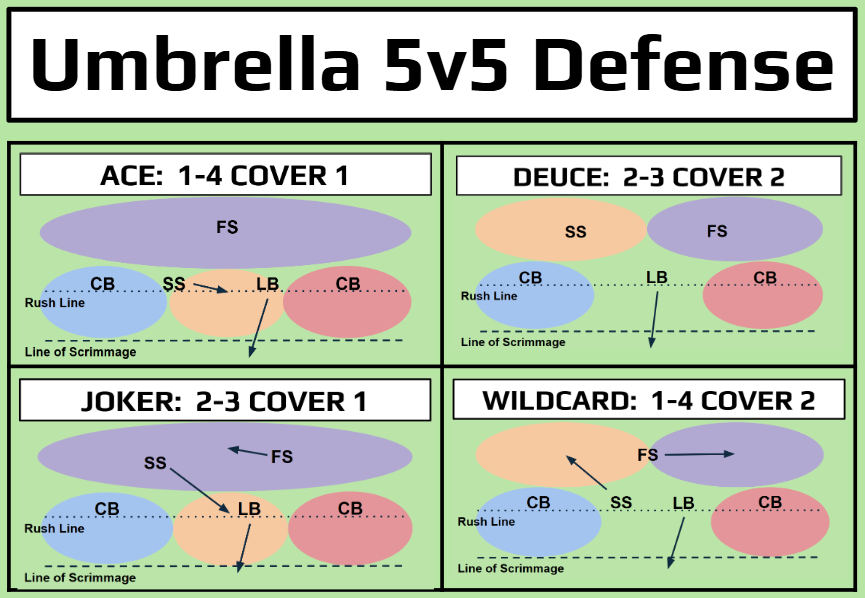
The Umbrella 5v5 Defensive System
- Ace: 4-1 Cover 1
- Deuce: 3-2 Cover 2
- Wildcard: 4-1 Cover 2 Roll
- Joker: 3-2 Cover 1 Robber
- Goal Line: 4-1 Cover 0