Play Description
When we’re facing a team that leans heavily on the run, we like to tip the odds in our favor by putting an extra defender close to the line of scrimmage. The Umbrella Defense’s answer to a strong ground attack is “Spy”, a 1-3-1 Cover 1.
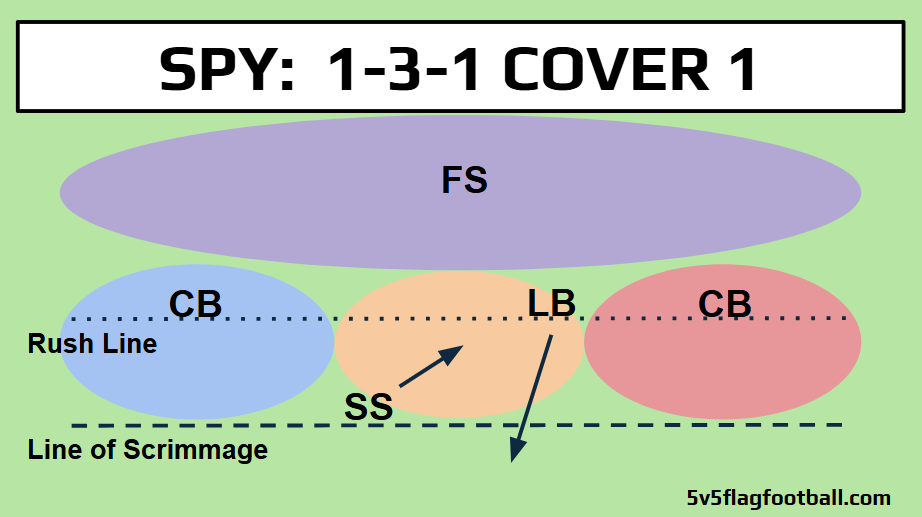
This defense places a versatile player, your Strong Safety (SS), on the line of scrimmage to spy the run (quickly react to a handoff or pitch). By offsetting the SS and the blitzing Linebacker (LB), we create problems in the backfield for opponents that can’t push the ball downfield through the air.
If run properly, Spy creates natural Umbrella team tackling opportunities. Your players should be gang tackling any running play with at least three defenders closing in on the ballcarrier. Runs up the middle are shut down by the SS and LB bracketing the runner while your Free Safety (FS) fills the alley. Outside runs are strung out by the Spill player. The Cornerback (CB), or Force player, has outside contain. Forcing the runner inside to their teammates. And the FS fills the Alley to stop forward progress and shut the play down.
The weakness of any flag football Cover 1 zone is the deep zone. If you are playing a run-first team that also has a good quarterback, Roll may be a better call. It allows your team to react fast to the run while also defending deep zones. However if your opponent’s QB hasn’t shown the ability to air it out, Spy is very frustrating for the coaches on the other sideline. We typically have an Assistant Coach keep an eye on the opponent’s QB during warmups to get an idea of what kind of arm we’re up against.
Alignment & Assignments
Spy puts your SS and LB in position to make a tackle for loss on any running play while also being sound against most passing attacks. It takes away easy completions in the short zones and forces your opponent to make tough deep throws to the sideline.
- Free Safety (FS)
- Alignment: Middle of the field. 10-12 yards off the ball.
- Stance: Defensive Back Stance & 3 Read Steps to the middle of the field.
- Assignment: Deep zone. Covering the entire field from 10 yards deep to the back of the end zone.
- Strong Safety (SS)
- Alignment: One yard off the line of scrimmage; 2-3 yards to the right of the ball.
- Stance: Defensive Back Stance & No Read Steps
- Assignment: Read run or pass.
- If run: Attack the ball. Make the tackle.
- If pass: Drop into the middle-short zone. 10 yards wide; 10 yards deep.
- Cornerbacks (CB)
- Alignment: Shaded just outside of the widest offensive player. 5 yards off the line of scrimmage.
- Stance: Defensive Back Stance & 3 Read Steps
- Assignment: Flat zone from the sideline to 10 yards inside. No deeper than 10 yards.
- Linebacker (LB)
- Alignment: 7 yards from the ball. 2-3 yards outside the QB’s non-throwing arm.
- Stance: Wide Receiver Stance to get a quick jump on the snap. Hand up to indicate blitz.
- Assignment: Blitz. Get a sack. Bat the ball down. Force a bad throw.
Final Notes
Our team ran 1-3-1 Cover 1 Spy a lot when the kids were in late elementary school. It was the perfect defense to attack offenses that couldn’t throw the ball more than 10-15 yards downfield. The SS and LB make a lot of tackles in the backfield o running plays forcing those teams into an uncomfortable position. They want to run; the defense takes it away. Then they go to Plan B; most young teams are not good at Plan B.
Once our kids reached Middle School age, we started to call Spy less and less. The opposing coaches rarely call running plays, and most QBs can at least threaten a 15-20 yard pass. This makes any Cover 1 zone defense risky. Instead we opt for Deuce and Roll. We defend against the big play and react quickly to handoffs and pitches to limit ground gains.
Check out our Umbrella Defense drills to improve coverage, force turnovers, break up passes, and pull more flags.